|
|
|
|
Three
Women and a Mystery
|
|
|
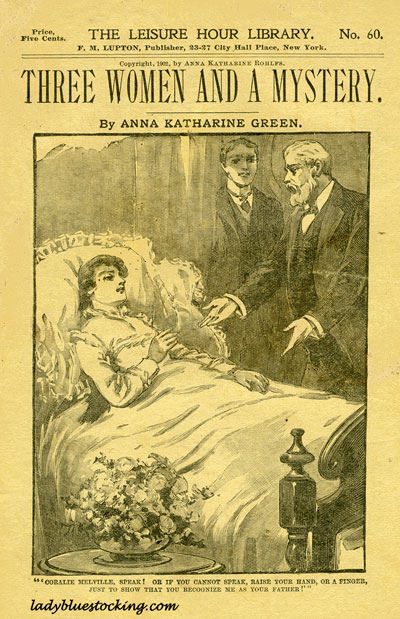
Three Women and a Mystery By ANNA KATHARINE GREEN Author of "The Leavenworth Case," "Agatha Webb," "Hand and Ring," " Without Codicil," "Two Men and a Question," Etc., Etc. CHAPTER I. A WANDERING SPIRIT. MY patient lay slumbering. A lovely girl, whose face I had been studying for a half hour, in the vain hope of reading the secret which hindered the recovery, that her naturally fine physique and the apparently joyous circumstances of her life, gave us every right, not only to anticipate, but to expect. Why did she halt just on the confines of health? Why did all medicines fail to exert their usual power in her case, when the case itself did not present, at least from a nurse's or even a physician's standpoint, any unusual difficulties? I had been installed here to find out, and I was not finding out. I knew no more now what ailed this sweet young creature, idolized by an adoring father and watched over by an anxious and indefatigable lover, than I did the first day I looked upon her wistful, suffering face. She had not talked. She was not too ill to enter into conversation, but she had no wish to speak, except in short "Thank you's" and weary plaints for water or some other soothing draught. But her fingers clung to mine when I grasped them, and at times I would catch the glimpse of a great appeal in her soft eyes as I bent to arrange her pillows or give her her medicine. At which sign of a heart craving for sympathy, my spirit would leap with anticipation of what she might say, and I would give her all the encouragement of look and touch which my position as her nurse warranted; but nothing ever came of it. (The Story Continues Below.) |
|
Three Women and A Mystery Continued: She remained silent and wistful, and I had no favorable report to give the doctor when he came, or any encouraging reply to bestow upon her father when he crept to the door at night and agonizedly asked if she had opened her heart or given me any clue to the misery which was secretly devouring her. For he, as well as all who came near her, knew that some dreadful fear or inner grief lay at the root of her malady. She could disguise much, but not that; yet her life, or what was known of her life, even by him who had nourished her from childhood, supplied no clue to any corroding distress or secret difficulty which could explain her present suffering. On the contrary, her lot had always been a happy one, and in promise was still happier. If the secret lay, as I had at first thought, in some sudden aversion to her contemplated match with the fine and prosperous gentleman she was engaged to, certainly the persistence with which she laid his portrait under her cheek at night, offered small evidence of any such change in her feelings, or of any change in her opinion of the young man himself, whose reputation so far as I knew was of the highest. It was all a mystery, but one I was determined to solve, if only because I loved her and had set my heart upon saving her. She was sleeping then and I was watching her, when something, I hardly know what, startled me from my reverie, and caused me to start up and look carefully around the room and behind me at the long French window, which opened out upon the veranda, which in this house was very near the level of the lawn. Of course I saw nothing—it was too late for anyone but myself to be up in the house and yet I remained uneasy, and presently rose to examine the window I have just mentioned to see if it was the shade I had heard flutter. Sudbury is a quiet place, and few precautions, if any, are ever taken against thieves or tramps, yet a closed window is highly desirable at two o'clock at night, especially when the room in which one watches is on the ground floor. I found that one of the two glass doors was slightly ajar, and was glad to latch and lock it. Yet the act did not afford me entire relief, the shade had given no evidence of having been stirred by the wind—indeed, there was no wind that night—nevertheless, I had assuredly heard something, and in this direction. Was there any one on the veranda outside, or on the lawn beyond? I did not like to lower my lamp suddenly, for that would betray suspicion; so, remembering that the adjoining room was empty, and that its shades were probably up, I stole thither with a soft step and peered cautiously out from behind one of its curtains. There was nothing unusual to be seen on garden-walk or grass—or so I thought at first glance. But as I continued to watch, I spied, by the faint starlight which illumined tlie peaceful scene, a shadow projecting from the corner of the house, which, with my memory of the trees and shrubs at that especial point, I could not account for. Convinced now that some one besides myself was awake about the premises, I went back to my charge. She was still asleep, but looked paler and much more wan than when I had left her a few moments before. Had the shadow of my own perturbation fallen across her sensitive spirit, or were the pulses of her life sinking lower with every minute she slept? Turning to the table beside her, I took up her glass of medicine and measured it with my eye. Why? I hardly knew. It was not time to give it to her, even if she had been awake. Yet I scrutinized it most carefully, and noted the very flower on the glass where the edge of the liquid stopped. As I put it down again my patient gave utterance to a slight murmur. It startled me as much as if I had been engaged in some guilty act. Meantime I found myself asking if the shadow I had beheld on the gravel was that of a man or a woman. It would make a difference, I thought; that is, in my fears, or whatever it was that disturbed me. If it was that of a man, I had but to ring the bell in my room and Mr. Cassetty would soon come and dispose of any wandering tramp attracted by a lighted window; while if it was that of a woman, it could only mean Miss Ffolliet, and Miss Ffolliet, I honestly believed, was a person whose movements were worth watching if she took to perambulating the lawn at night and fingering the lattices of the windows where my sweet, young patient lay hovering between life and death, and losing, or seeming to lose, her hold upon the former with every breath she drew. For Miss Ffolliet, although a trusted member of the household, had a way with her that I did not like. She struck me as a person on watch, and for no real good. I found her sometimes in the sick-room, when she had no real reason for being there; and I was sure that I detected her once with her hand on the medicine bottles. She had a pretty face which, when she smiled—and she smiled, I thought, too frequently—assumed an aspect of good nature which imposed on Mr. Cassetty, and to all appearance on my patient; but when she did not smile, and this was when she thought no one was looking at her, it took on quite a different aspect, and from this aspect I recoiled, for it was not that of one whose conscience is quite easy, or who would wish her thought's to be read openly by the world. Then I had heard her speak with open disrespect of one— But on this I will dilate later; enough that I had small reason to like this woman, and small reason for believing that she was as devoted to Mr. Cassetty's interests as she had made him believe. Nor do I think that the doctor held her in any better estimation than I did, for had he not told me, on that memorable day he installed me at Miss Cassetty's bedside, that I was to distrust everybody in the house, with the solitary exception of her father? And who could he have meant by that everybody, if not Miss Ffolliet? Surely not the servants, who, one and all, were of the old-fashioned type, and manifestly honest and devoted; and still more positively, not Mr. Melville, who was— Well, I will not say what he was. I find it difficult to speak of him at all. only it could not have been he the doctor meant, for the doctor has eyes and an understanding, and must know a perfect gentleman when he sees him. No! it was this woman he meant— this young and softly smiling woman, who seemed to be in all parts of the house and always looking, looking for some opportunity which never quite came, unless it had come tonight in these wee small hours when she might easily have thought I would be slumbering in my chair. If this shadow should prove to be hers— but at the thought I crept back again into the room I had just left, and took a second peep from its perfectly dark window. The shadow which had attracted my attention a few minutes before was gone. Unbroken moonlight on the lawn; unbroken moonlight on the walk. Whoever had halted just short of the corner had withdrawn. Whither? Ah, that was what it had become my present duty to find out. Slipping from the window I prepared to cross the floor in the direction of my patient's room. But as I neared the door I heard a sound at the bedside which convinced me that, in leaving Miss Cassetty for a moment I had subjected her to the very intrusion I had secretly feared, some hand had clinked the bottles, standing on the small table at the bed-head. As that hand could not have been hers, no doubt remained in my mind as to who the meddler was. Pausing in my swift advance I first listened for another move within, then slid quietly forward. As I passed the crack of the door I caught one glimpse of my patient and the bed on which she lay. Certainly that was a hand and arm I saw stretched across the table I have mentioned, but when I followed up my discovery by a quick rush which carried me round the door and over the intervening threshold, another and a quicker rush took place within, and I arrived just in time to perceive the tail of a vanishing skirt disappear into the hallway through a further door. I was not long in reaching that door; but swiftly as I moved I could not overtake the intruder. By the time I was in the hall she had entered the library opposite, and when I thought to catch her there a slight click in the direction of one of the windows told me that she had escaped from the house, and that if I wished to come upon her I must seek her on the lawn or in the garden walks, where I had so lately traced her shadow. Meanwhile I had leaped to the window and looked out. Yes, she was there! I could see her tall and carefully enwrapped figure outlined against the moonbeams. She was making for the gate; in another moment she would be in the road. Where to go? That was of small consequence now. The proof of her duplicity was to be got within the walls rather than beyond them. I had but to go to her room and discover her bed empty, to have all the evidence I needed in the attack I meant to make upon her character in my next interview with Mr. Cassetty. Filled with this idea, which I felt impressed was a most happy one, I first carefully locked the window of which she had made such traitorous use, then, with another quick glance into the room where my still sleeping patient lay, I turned toward the staircase, which I had never before found occasion to mount. I felt that I knew my way. Molly, the maid, had more than once spoken of Miss Ffolliet's room, and of how Mr. Cassetty had been careful to remove her to the one over the library, so that her stepping out overhead should not disturb Miss Cassetty. By fixing the exact position of the library on the lower floor, I could make no mistake as to which door I ought to enter on the one above. Yet it was not an agreeable errand I had undertaken, and I felt something like a thief as I wound my way upstairs in the dead of night, without even a lighted candle in my hand, into regions I was not supposed to invade, save on an errand of life or death. But was this not an errand of life or death? I was certain that it was, and so gained courage for my task. The moonnght, which had freer access above than below, stood me in good stead as I glided past the stairhead and took that turn to the right which I felt convinced would lead me to the two guest chambers. By its aid I could see both their doors, and decide without the least hesitation which led to the room directly above the library. But when I reached it, I found that it required more hardihood than I had previously supposed, to turn the knob and cross the threshold. Though I knew the room to be empty tliere is something about an intrusion of this nature which might well make a sensitive person shrink. But one thought, given to my sweet young patient perishing so mysteriously from causes to which these strange actions on the part of one I felt to be secretly inimical to her, might possibly serve as a clue, nerved me to dare whatever self-reproach might follow my otherwise unwarrantable act, and, without pausing for a second recoil, I opened the door and entered. A sound of gentle breathing drove me back in great confusion across the threshold. I had made some mistake in the rooms, afterall. This was Mr. Cassetty’s room, or worse still, that of his guest and brother-in-law, Mr. Melville. But no, this was no man's room. Woman's clothing lay on chair and bureau. This the moonlight readily disclosed. It was Miss Ffolliet's room I had entered—Miss Ffolliet's room, and some one lay sleeping in her bed, while she roamed the road I could dimly see stretching away through the open window. Who could the sleeper be? I was resolved to find out, and, nerving myself once more, I advanced again into the room and approaching the bed, looked quickly and earnestly at its unconscious occupant. It was Miss Ffolliet herself. The woman whom I had come upon below, and who, after visiting Miss Cassetty's side, had vanished from my view in the direction of the highway, was a stranger, no member of this household, but a stramger! CHAPTER II. IN THE LIBRARY. On his first visit to the sick girl, next morning, Mr. Cassetty remarked upon my jaded appearance. For reply I cast a meaning glance at his daughter's pinched features and slowly wasting hands; then, as his face fell, I asked if he would see me for a minute in the library. He led the way with alacrity. But before I joined him I was careful to send Mollie into the sick room, with an especial caution not to raise the shades at the windows, and not to leave the bedside for a moment. Mr. Cassetty turned a deeply alarmed countenance upon me when I finally stood before him. "Is she worse?" he asked, "or have you found out her secret?" I am afraid I assumed a mysterious air. I know that I looked behind me at the door to see if I had closed it as carefully as I had intended. "I don't know what I have found out," I replied. "Certainly, something is amiss. A woman appeared at one of the long windows last night, who later found her way, into the house and even into the sick-room. What she wanted there I do not know, but I cannot think that it was for any good." And I went on to relate the whole experience, omitting only all reference to Miss Ffolliet, to whom, in thought, at least, I had done such rank injustice. He listened, first with astonishment, then with an uneasy display of a much deeper and not so readily- to- be -understood emotion. But when I looked the inquiry I hardly dared to put into words, he confined himself to the simple assertion: "I am as much at a loss as you are. I know of no woman who would be likely to obtrude herself by night into my house much less into the room where my darling lies ill. I have no doubt you have made too much of the whole thing, but I will institute inquiries when I ride into town. Perhaps I can learn at the hotel the name and identity of this midnight wanderer." I bowed and attempted to withdraw from his presence. My duty had been done and upon him fell the responsibility of the rest. But he was not so ready to see me go. Coralie was his only child— his only hope in life, I may say, for his wife had been dead for years, and his heart was sore with the mystery of her malady. “I would like your advice," he began, pushing a chair towards me and seating himself. "Shall I make another and stronger effort to get my child's confidence? In short, shall I ask her in so many words what disturbs her, and thus force from her the truth I cannot win by other means from her lips?" Impetuously I shook my head. "I should be afraid," I objected. ''In the few days I have nursed Miss Cassetty I have noticed that the sight of your face makes her tremble, and that she is invariably worse just after your visit." “And after Mr. Beauchamps?" "The result is the same." "Then she is keeping something from us both. What, God only knows. Can it be a sudden distaste for the marriage she is pledged to?" . “The interest she shows in her lover does not look like it," I ventured, seeing that he expected some reply. "I have detected her more than once weeping over his picture, and last evening I saw her bestow a passionate kiss upon the flower he left at her bedside. She does not recoil from this marriage. On the contrary. But"— "But what? Why do you hesitate?" "Will you pardon me if I venture a question? Why does she stare so long, so earnestly and, I might even say, so pitifully, at the little scar on her left arm?” “The little scar?" His face fell, yet grew strangely soft at the same time. “Does she look at that?" "Often, sir, and always with an expression I should be glad to picture to you if I could." He started up, and took a turn in the room, in a vain attempt to hide his emotion. "She is thinking of her mother when she does that," he finally declared, with subdued tenderness. "Poor child. If her mother had but lived we would not be standing here helpless in the presence of a mystery we can neither reach nor understand." Then, marking my distressed face, he went on to say; "That little scar is very dear to me for it was the means by which I came in possession of this precious child." I looked my amazement. What did he, what could he mean?" "You have not heard the story," he exclaimed. "Well, that is not strange. Folks cannot talk forever about old tragedies. Still, I thought everybody in Sudbury—. But no matter. You shall hear from my own lips the romantic history of my little Coralie, if only to give you an even greater interest in her than you now have. Mr. Melville, who is now my guest and whom you have probably met about the house, married his wife on the same day that I married mine. The two girls —beautiful, I assure you, but quite unlike each other in style and appearance— were twins, and had never before been separated. Melville, who was a dashing beau in those days—I'm not sure that he is not a dashing one yet—had little patience with the grief displayed by his bride when the hour of parting came between the two, but I was of softer mould, and seeing the almost inconsolable sorrow that darkened my wife's eyes as her sister threw herself weeping into her arms, I promised them both then and there, and before they ever left their father’s roof, that I, for one, would not stand between them, if the day ever came when their need of each other's companionship rose to the point of suffering. "And this was why, at the end of another year, the width of the continent separated me from my wife when the time of trial came to her, and why, tied down to my office by heavy business cares, I was not able to hasten to her, or, indeed, look forward to a sight of my child till the condition of both warranted their long journey home from the Pacific coast. Mel¬ville's wife had given birth to a daugh¬ter, also, and Helena—that is, my wife— being thus relieved from special care, was very happy—happier than her unfortu¬nate sister who (let me be frank with you, for I am telling nothing that is not well known to all our friends, had not made the wisest choice in the world, as attractive, clever and handsome as you see Mr. Melville to be. "He lacks sympathy, or, perhaps, I should say, a proper understanding of a woman’s needs and the delicate nature of her sensibilities, and when he found that she had given him a daughter instead of the son he had built upon, he showed his disappointment so unpleasantly that my wife was shocked, and could not tear herself away from her sister's side, even after she herself was well and strong enough to venture on her homeward journey. Alas! This sympathetic lingering on her part cost her her life. A fire broke out in the hotel where they all were staying, and when Melville, who was away at the time in his eternal search after amusement, returned to the charred ruins, it was to find only one remaining of the little group he had left in health, if not happiness, a few days before, and this an infant, who, by a strange freak of fate, or possibly through the last effort of one who could not save herself, had been found lying naked but unharmed on a pile of tossed-out clothing in an inner court. This infant, who, as you probably judge, was Coralie, Melville instantly declared to be his, although, as he afterwards acknowledged, he had never seen any difference in the babies, and always had been obliged to ask which was his when he saw the two together. His reasons for this claim were seemingly good, and no one thought of disputing them. An article of his wife's was found in the gallery above, where so many flying souls had succumbed to the devouring flames, while Helena, who had not got so far, and who had been recognized by the ring she wore, had been discovered with a baby clasped close to her breast, whom no one thought of denying to be her own, until I arrived in San Francisco and saw the surviving infant. And why could I dispute it then? Because on its little arm was the scar of a deep scratch, which my wife had mentioned in a letter I could show, as having been a mark identifying her own child from that of her sister's, whom, otherwise, she resembled. Do you wonder that I regard this little defect in Coralie with the fondest love? Had it not been for this distinguishing mark and the letter which described it, my brother-in-law would have maintained his claim, and I could never have said him nay. So now you understand why I say that this little scar was the means of securing to me this child. And must I lose her now! Advise me, Miss Ladd. You have nursed many persons seemingly as near death's door as my little Coralie. How shall we save her? Medicine will not do it. Even the doctor says this. What means are left to us, then?" "May I be allowed to make a suggestion," broke in a wholly unexpected voice from the other end of the room. It was Mr. Melville's voice—the voice of the man Mr. Cassetty had rather freely criticised. When had he entered? How long had he been there, and how had he enjoyed this raking up of old griefs, to say nothing of the pointed allusions to himself. Impossible to say; his manner as well as his tone was simply courteous. "I have been anxious to speak for some time," he suavely continued, coming slowly forward. "Coralie needs a shock—a pleasant shock, of course. Shall I suggest a means of giving it to her!" He was now in the broad belt of sunshine pouring in at the east window. It had been my good fortune to come upon him once, if not twice, every day during my week's stay in this house, but never had I chanced to encounter him when his features looked handsomer or his bearing more distinguished, than at this embarrassing moment. His smile, too, was like the sunshine he was himself bathed in, and if he had been affected by his brother-in-law's description of his unsympathetic character, he certainly did not show it. In fact, he seemed too bent upon presenting to us the proposition he had hinted at. His cheek was quite red with the ardor of his own interest in what he had to say. Mr. Cassetty, whose own cheek had flushed from a very different cause, stopped short in his attempted apology as he met the other's glowing and eloquent eye. "You have an idea!" he asked. "What is it? You must be almost as anxious to save this child as we are." "Almost!" the other echoed, with an odd and deprecatory motion of his smooth, white hands. "You do injustice to my deep, my absorbing desire. And this you will see if you will listen to me a moment." And, linking his arm in that of his brother-in-law, he drew him down the room to a further window, where he stopped and whispered a few short sentences into his ear. They seemed to work wonders. When Mr. Cassetty returned to where I stood, awaiting him in secret tumult I did my best to conceal, I was astonished at the change in him. "Call Miss Ffolliet," he admonished me, without the least explanation of his intentions. "Send me Molly, and Patrick, and all the boys lingering about the stables. I will try the effect of what Mr. Melville suggests. The dear girl needs to be roused, and we will rouse her, and in a way a girl as ill as she has never been roused before. Now, where is Beauchamp? Who will send me George Beauchamp?" Something in his manner, or his orders, or the smile with which Mr. Melville listened, startled me deeply. I felt dizzy, frightened. Bringing myself again to Mr. Cassetty's notice by timidly laying my hand on his sleeve, I ventured to say: "May I not inquire what you are contemplating? A pulse as uncertain as hers cannot bear too strong or too sudden excitement." But this man, filled with his idea, entirely failed to heed me. "Are there roses in the conservatory?" he shouted. "Go and see. We want quantities of them—quantities. Ah, Miss Pfolliet," he exclaimed in great relief, as her head showed at the door, "We have work for you—exciting, interesting work! Come here and I will tell you all about it. You, Miss Ladd, may now return to your patient." CHAPTER III. EXPERIMENT IN EXTREMIS. I REENTERED Coralie's presence in a state of mind which was something of a mystery to myself. I felt like crying—I felt like running away—I felt-like—well, on the whole, I think I felt most like staying right where I was and watching over my poor darling. Her aspect, as I took Molly's place at the bedside, was very touching, but far from reassuring. One of the roses which her lover had brought her the day before was in her hand, and it was held so feebly that it nodded against her lips, where it hardly moved with her breath. She looked like a person trying to die. She scarcely noted me as I approached the bed, and when I ventured to ask her if she felt equal to seeing company this morning, she answered only by languidly unclosing her lids and letting them wearily fall again. Anxious and greatly troubled by a situation I did not understand, I looked up at the clock. The doctor did not usually come till ten, and it was not yet half past eight. Would her critical condition tend to hasten him this morning? I began to hope so. Certainly his presence was needed here, for advice if not for action. I, young and inexperienced and shaken, with feelings I dare not acknowledge to myself, was totally unfit to cope with the present situation, unaided. An hour or so passed, and while I was hesitating whether or not to send a secret messenger to meet him, I heard a little gasp from the bed. Turning that way in some apprehension, I was delighted to see that my patient had roused herself and was looking in the direction of the doorway with something like a gleam of interest in her eye. I did not know whether to be encouraged or alarmed, when I saw who and what had attracted her attention. Miss Ffolliet, with a smile which, whether real or assumed, was certainly full of sparkle, was entering with her arms laden with fluffy laces and other choice treasures from Miss Cassetty's wardrobe. Behind her followed one of the men, with an arm full of fresh flowers, which he motioned me to take from him. Everything they carried was pure white. Coralie, with a suspicion of color in her cheeks, stared at the unwonted gear that was being brought to her bedside, and then at the unusual array of flowers. "What are you going to do?" she feebly demanded. Miss Ffolliet laughed—cheerfully, and with a toss of her head, which made her look some half dozen or so years younger. "Make you beautiful," she replied. "You are better this morning, and the doctor says that you may see a few friends." The doctor! So much was a lie, I knew. The poor young thing, startled and perhaps a little frightened, shrank into her pillows and feebly shook her head. But she did not close her eyes, and followed, with growing curiosity, the unfolding of these delicate laces and their deft bestowal about her wasted neck and arms. "George is coming," explained Miss Ffolliet in a whisper. "But he comes every day," faintly remonstrated Coralie, glancing from the other's quickly moving hands to the flowers which I was endeavoring to dispose with some sort of taste about the room. "Why all this preparation today? Are we," she asked, with a faint, very faint semblance of humor, "are we going to have a party?" "Perhaps," Miss Ffolliet slyly admitted, with a demure pucker of her lips, which I did not know whether to admire or bitterly hate. "A few rosebuds here, Patrick. Oh! but the effect is pretty!" she impulsively exclaimed. She had twined them, even while speaking, into a sort of wreath, which she let fall on the sick girl's forehetd and across the pillow. "Oh, why do you do that? What is going to happen?" persisted the sick girl, trying to lift her head, weighed down by this lovely and fragrant burden. But the other, with a calming "Hush!" pushed her back, whispering, as Miss Cassetty turned, with sudden appeal, in my direction, "George wants to tell you himself. See! he is at the door. You are not afraid of George?" She looked as if she might be, at this minute; but quieted down as he came bounding in, with a face so eager and tender that it seemed to fill the room with brightness— and suffuse every heart with hope. But, though I could not but respond in a measure to the smile he threw about him, I was not without a secret apprehension lest the result of the attempt I now began to understand should be different from what was expected, and turned to glance out of the window, with increasing anxiety to see if I could not detect the approach of the doctor's buggy down the road. What was my astonishment, not only to hear his old horse whinnying in front, but to see more than one cart drawing up to the door. Truly they had worked fast in the other part of the house, and with the doctor's assent, if not with his open assistance! And yet, though somewhat relieved, I did not feel quite easy, for I felt that I had had opportunities of knowing Coralie better than any of them, and that what to them might contain only the elements of joyful surprise, might work far otherwise on her delicate and grieved spirit. I therefore trembled at the confidence displayed by this thoughtless young lover, and would have been glad to have signified to him in some way to think again before he subjected this half-fainting girl to an ordeal of which no one could prophesy the outcome. But this was no longer to be thought of. Before I had completed the gesture by which I hoped to attract his attention, the door had again opened and Mr. Cassetty appeared, followed by the good doctor and another gentleman, whose garb, even if his person and calling had not been well-known to us all, proclaimed him to be an Episcopal clergyman. It was Dr. Rodman in full canonicals, and Coralie, seeing him, received the contemplated shock so lovingly, if unwisely, prepared for her. "Oh!" she screamed, starting up and falling forward on her lover's outstretched arm, with a look of terror, it not anguish, which made every heart there stand still; "Why have you brought in Dr. Rodman? Why is a clergyman here? Did you think I was dead, and has he come to bury me?" There was hysteria in her tone, but alas! not simply the hysteria of overexcited nerves or a broken down physical system, but of a mental agony of no conceivable depth, and I did not wonder that Mr. Beauchamp threw his arms round her, crying, softly: "No, no, you mistake. Guess again, my darling. A clergyman has other duties than the sad one you so suggest. I know of one altogether joyous, and it is for that we have called him. Won't you welcome him, dear? Won’t you let him marry us—marry us now, so that I can stay with you, watch over you, and show you such devotion that you will feel it your duty to get well, if only to reward my hope and care." Oh! What a look she gave him! In it I saw love, despair, longing and a certain wild hope which made me think she was going to yield and make a snatch of happiness out of the very mouth of the grave. But no, I had mistaken her. She could not give herself up so readily to joy; she had a question to ask first, not of him whose reply she might well doubt, not of her father, towards whom her eye roved passionately, and with that searching scrutiny given to sufferers upon whom the shadow of death had fallen, not even of Mr. Melville, who had just joined the group standing at the bed-foot, but of the doctor, whom she beckoned to her more by her glance than by any movement she could make. "Doctor," said she, as he stooped to meet her eye, "you have never deceived any one who asked you from a bed of sickness the solemn question I am going to put to you now. Is my condition hopeless? Shall I die soon and anyway, whether I yield to Mr. Beauchamp's wishes and am married here today, or not?" "No," returned the doctor. "I believe you will live, if such an incentive as marriage is given you. All that you need to enable you to throw off this weakness is determination and a happy heart." "Oh!" she murmured, letting her head fall forward over her lover's arm and lying so long that her father grew anxious and joined the doctor and Mr. Beauchamp at the bedside—and even Mr. Melville betrayed a nervousness which led him to move where he could more plainly watch the changes on her face. "I have simply to be happy," she faintly repeated, "and I will live. I was in hopes that you would say that I must die and die soon, whether I was happy or not." Then, as everybody stood aghast, she plucked the wreath from her head and holding it in failing fingers, looked around her long and earnestly, first at her lover then at everybody in the room. As her glance crossed mine, I instinctively held out my arms. But she did not seem to heed me or mark the movement, or that made by any other person in the room. Her eye traveled on automatically, finishing its course with Mr. Melville. Did she forget to take it away again? She seemed to, for she was still looking at him with a strained and unearthly gaze, when this strange and impetuous cry burst from her, lips: "I cannot! I cannot! I cannot marry now, I cannot marry ever. Leave me to die. It will be better for me, better for George Beauchamp, better for us all.'' And with a moan, in which she seemed to bid farewell, not only to happiness, but to those her failing heart still clung to, she withdrew from her lover's arms and sank back fainting on her pillow. And thus, from causes no one seemed to understand, ended the experiment sug¬gested by Mr. Melville, and entered into with such hopeful confidence both by her father and her lover. CHAPTER IV. THE THUNDERBOLT FALLS. HAD I been more fully acquainted with each and every person present, I might have interpreted more justly the various expressions of sorrow or dismay I heard about me as I hastened forward to assist the doctor in restoring poor Coralie to consciousness. As it was, I seemed to catch only astonishment mingled with self-reproach in Mr. Cassetty's abrupt exclamation, and a mixture of feelings in Mr. Beauchamp's countenance, some of which seemed born of tenderness, and others of the incredulity and dismay awakened by this passionate renunciation of his claims upon her. Mr. Melville said nothing, but it was easy to read his grief and chagrin at this unexpected ending of the daring attempt he had suggested. The rector had discreetly withdrawn from the room at the first intimation that his services would not be wanted; and Miss Ffolliet, peculiar and mysterious as ever, had carried her wonder and regret behind the curtains of one of the windows. When I could spare one look from my reviving patient, I found that I had not been deceived in my estimate of Mr. Melville's feelings, whether I had been in those of the others or not. He looked not only anxious, but ready to atone for the undeniable blunder he had made, and it was his voice which was first raised in anything like distinct speech, Mr. Cassetty being held silent by the mystery, and Mr. Beauchamp being too much under the sway of conflicting passions to find any help or solace in words. What Mr. Melville said struck me, if not the other persons present, as much to the point. First urging patience, he proceeded to say that in his opinion it was delirium, and delirium only, which was answerable for Coralie's forcible rejection of what they all knew was the dearest wish of her heart. She loved George Beauchamp, and had, within a very few days, talked gaily and hopefully of her prospective union with him. Then what but the condition of her mind could lead her to repudiate the very idea of marrying him and invite death to release her. “She is ill; more so than I thought,” he concluded, in the mellow, magnetic tones which invariably roused attention, whatever the circumÂstances or however other minds and hands might be employed. "But if you will allow me to speak a word to her, I think I shall be able to obtain from her a kinder and more appreciative expression of her wishes than that which you have just listened to. Though circumstances have prevented my ever seeing much of her, I flatter myself that I am not without influence with one who came so near to calling me father. At all events she will not dread being either scolded or urged into what is objectionable to her instincts or nice sense of duty, by me." Manifestly he was an infrequent guest, and as such not accustomed to intrude himself in family matters, for astonishment sat on every face, assuming in Mr. Cassetty's an aspect of anger and in Mr. Beauchamp's that of an undisguised hostility, which made me suspect, for the first time, that this ardent but proud young man did not rate Mr. Melville's superior attractions and erratic but kindly impulses at their true value. But neither gave utterance to any open dissent, and I could easily distinguish Mr. Melville's step approaching behind me. Consulting the doctor with a look, I drew to one side just as the latter drew to the other, and Mr. Melville glided in between. Coralie, who was almost herself again, gave him very little encouragement to address her, but when she saw that he was bound to speak, she feebly motioned for us all to fall back and leave her alone with him. We obeyed, but hovered near, with our eyes on her drawn, set features. Mr. Melville, with a half caressing yet quite determined manner, sat down on the side of her bed, and with a last glance in the direction of the two men who showed so little faith or even interest in this fresh attempt to influence this unhappy girl, he took her hand in his and whispered in her ear a few words. They must have struck home, for she paled, if one may so speak of one who was white as the driven snow before, but listened with trembling lips and averted eyes while he asked her a question or two. The latter seemed to move her strangely, and offered some suggestion. Scarcely did she seem to breathe; but as the doctor made no move to interfere I dared not, and presently we saw her lips stir and a faint murmur issue from them. When this ceased, Mr. Melville rose to his feet and faced George Beauchamp. "Coralie is sorry," said he. The simplicity of the words and the tenderness with which he uttered them, roused her as nothing had roused her yet. ”Yes," she cried, starting up, a hectic flush lighting each cheek, "I am sorry if I was unkind or wild or anything I ought not to be. If George will forgive me and call Dr. Hodman back, I will be married gladly. But let it be now, now." Melville, with a look of triumph I thought quite excusable, made way for the eager lover. Miss Ffolliet, who suddenly appeared from behind her curtain, stepped to the door, and made a gesture to some one standing outside, while I, in my position at the bed-head listened, because I could not help it, to the few words which now passed between the two brothers-in-law. "Melville, you are certainly an unknown quantity," was Mr. Cassetty's odd remark. "What could you have said to Coralie to influence her so speedily. I did not suppose she would listen to you for a moment. What was your argument, may I ask?" “Oh," was the other's careless retort, "I simply took it for granted that she had not been herself when she spoke out so vehemently, and gave her an opportunity to recall her words. It really cannot be, you know, that she does not want to marry George; she was simply frightened at the suddenness with which the ceremony was proposed to her. You will find, however, that the shock of the event will make a new woman of her." Mr. Cassetty's reply was doubtless interesting, but I did not catch it, for at that moment the clergyman reentered and took his old stand at the foot of the bed. Other persons came in, and Mr. Beauchamp, with an encouraging word and smile to his nearly collapsing bride, raised her once more to a half-sitting posture, while Miss Ffolliet rearranged the laces about her and dropped a mass of blossoms on the bed. Dr. Rodman opened his lips. "Be brief," murmured someone. The bride's breath came in great gasps; I wonder the doctor allowed the ceremony to go on. "Dearly beloved"-- "Pardon me," broke in Mr. Cassetty, with sudden remembrance, "we have forgotten the ring! Coralie would not feel married without a ring. If you will wait just one instant, I will get her mother's for her; that will consecrate this marriage. Where do you keep it, dear?" This to the quivering, startled bride. "I—I don't know," she stammered. "I—I have forgotten—let me be married without one. I—I'd rather." There was something in her tone, and in her manner, also, that was quite strange and unnatural. We forgot that she was ill—forgot that the cord was strained almost to breaking, in the wonder and curiosity aroused by her mysterious emotion. "You do not mind being married without a ring?" she continued, looking up with pleading eyes into her lover's face. He hesitated; love can blind a man to much, but not to everything. "Let your father fetch the ring," he said; "it cannot be far from your jewel-box; its associations are much too solemn and precious." Her eyes filled, not with tears, but with an agitated recognition of some secretly known possibility, which made her look haggard in a moment. She moved in his arms and looked about her as if for succor, but recoiled and shook her head as the doctor leaned toward her. "It is mental help she needs," murmured that good man, drawing back to my side. "We can do nothing for her." Meanwhile Mr. Cassetty had left the room, followed by Miss Ffolliet, and the constraint of the ensuing silence was almost too much for us all, to say nothing of the trembling bride. One person only showed no distress. That was the ever suave, ever hopeful, ever self-possessed Mr. Melville. He seemed to have some resource in view which gave him great confidence. Perhaps it was connected with the little ring I saw him fingering on his watch-chain. Suddenly there was a cry from the bed: "I cannot stand it; if you love me, George, let Dr. Rodman proceed!" "Without your father!" "Oh!" came from her lips, "I forgot; not without my father—oh! not without my father!" and her voice rose to a scream. The physician now interposed. "Had I known that everything would not go smoothly," he warmly protested, "I should not have given my consent to this marriage, for which my patient is evidently not quite prepared; and I would now advise"— But here his words were cut short and our attention immediately distracted by the hurried reappearance of Mr. Cassetty, in a state of increased agitation. Walking directly up to where his daughter lay in a species of white despair, he said, in what he doubtless meant to be a subdued tone: "Your mother's ring is missing, so are most of your other jewels; have you been robbed, Coralie, and without telling me?" She seemed to shrink into the very heart of the laces piled about her. "Yes," she admitted, with a burst of sobs. Then, as a murmur rose about her, and one voice repeated, "Robbed!" she caught herself together in a sort of spasm of courage and, looking up with a piteous attempt at self assertion, exclaimed: "Not robbed; I gave the things away." "Gave!" It was her father who now repeated her words in horror. "Gave! Your mother's ring taken from her hand in death, and which was the sole token by which we recognized her. Gave! The corals which never left your childish neck, and gave meaning to your name. Gave! Your grandmother's diamonds, precious as valuables, but still more precious for the murmured blessing with which she placed them in your hand on that solemn evening when she died. Gave! And to whom, if I may ask? Not to your promised husband! He is too much of a gentleman to accept them." He had forgotten her helpless state, and stood over her, stern and implacable, demanding a reply which she did not seem to know how to make. Mr. Beauchamp'a face had changed also; and while a simple shrug of the shoulder answered Mr. Cassetty's allusion to himself, this high-spirited and sensitive young man showed in every line of his face that he felt only too keenly that here was a mystery which she ought to clear up at once. "To whom have you given these jewels!" insisted the father. "Whisper the name in my ear," urged her lover. "I cannot," she moaned. "Let the clergyman go on; I will tell you afterwards." But George Beauchamp, who comes of a very proud race, with no recorded blot on its history, resolutely shook his head, and, while gentle with her, replied with quiet dignity: "No, Coralie, we will not enter into marriage with any secrets between us. If our friends here will pardon the trouble we have put them to, we will postpone this ceremony till we can both enter upon it with free and light hearts." And with a bow to the deeply humiliated father, he rose from the bedside. Thus repudiated in her turn, Coralie lay crushed under her load of shame. Searching in wild entreaty for a sympathizer among the persons about her, she caught my eye and feebly thrust out her arms. "Hide me," she cried. "Bury my face away from them all. Throw your arms about me, and let none of them see me again." But her father would yield to none other this task, and took her to his breast, even while launching a question at young Beauchamp. "You refuse to marry her, then?" he asked. The year-long lover, the all but husband, paused, looked back softened at the touching spectacle of stricken father and cowering bride, then slowly, but resolutely, hardened himself again to a cold but dignified courtesy. "Miss Cassetty will herself wish to explain as soon as she is able to view this matter clearly." Able! Some of us thought she would die before the words had left his mouth. But she did not; she even started up, alert and eager, as a new voice—a voice which had been silent during these last few minutes—struck in, with sudden decision; “This is all an insult to Miss Cassetty—as you are now pleased to call her. Explain, she—when she can hardly utter two words from weakness! Shame, gentlemen! What if her jewels are gone? You surely don't suppose she gave them where she should not?" It was Mr. Melville, and I, for one, thought his attitude noble. "I have said to Mr. Cassetty all that I had to say on this subject," replied the young man. "Pardon me if I do not reopen the conversation with you." A sneer, poorly veiled, emphasized that "you" more than did his tone. Evidently he carried his dislike to this handsome and kindly man beyond the bounds of politeness. I looked to see Mr. Melville recoil, or at least show some feeling at so open a rebuff. But, on the contrary, his bearing took on an additional courtesy, and he smiled, though with a slight underlying disdain, as he answered: “But you will have to hear me, and answer, too, if you do not immediately take Coralie's hand in yours, and not only apologize for your late words, but emphasize your apology by an immediate marriage. We cannot let this dear girl suffer because of your unreasonable jealousy in a matter with which as yet you have no real concern. I exact from you that Dr. Rodman be allowed to proceed with this ceremony so unhappily interrupted." "YOU exact! and by what right, let me ask? I never saw you till a week ago, nor has Coralie ever told me that you possessed any special rights here, save as a guest who, some twenty years before, was married for a short time to her mother's sister." "Coralie is no talker; so much you must have seen today," was the quiet retort, "and if I have no rights in this house save those of a passing guest, I have rights over this child which I am bound you shall respect. It was to me she gave those jewels! I did not wish to acknowledge this, since the declaration will cause great trouble and disturbance in this family, but I cannot see the innocent compromised. She gave me her jewels and I took them, not because I am no gentleman" (this to Mr. Cassetty, who stood aghast at this revelation, which certainly astonished all present), "but because she wished to show some favor to one who, from her birth, had received nothing of all the dutiful recognition she owed him. Thomas, a blow is impending over you, which I grieve to let fall." (This still to Mr. Cassetty, now facing him in a white heat of intolerable suspense. You have cherished and brought up this dear girl as though she were your child. You believe her to be so. But she is not —she is my child! And it is this knowledge, coming to her after twenty years of confidence in her relationship to you, which has prostrated her and made her unwilling to marry till she can do so in her right name. Coralie, is this not so? Coralie Melville, speak! Or if you cannot speak, raise your hand, or a finger, just to show that you recognize me as your father, and that I am not uttering a brazen falsehood! She does! She lifts her hand! She owns me for her father, as I now own her for my child! May God help you, Cassetty!" CHAPTER V. TWO O'CLOCK IN THE MORNING. IT would seem that this allusion to the gesture made by Coralie would draw all eyes her way. But it failed to do so, so great was the interest felt in Mr. Cassetty, struck thus in the very core of his being by this devastating blow. Coralie not his! You might as well have told him that the blood in his veins belonged to another man. He laughed as the words left Mr. Melville's lips, derisively at first and with a gurgling sound of rage, which made those who credited Mr. Melville with speaking the truth, and admired while they hardly approved his attitude, tremble lest the next minute should see them at each other's throats. But as he continued to meet his brother-in-law's eye fixed upon him in straightforward and unabashed assertion, he gradually lost his aspect of inconceivable disdain, and took on a pallor so dead white that we began to dread some worse termination of this scene than a hand-to-hand encounter, and were more than relieved when he gasped out, with a sudden attempt at self-control, touching enough in view of the frightened face on the pillow: "You are playing with me, Melville. Never, from the day I first gave you my reasons for believing this child the offspring of my wife, Helena Cassetty, have you ever raised a protest or opposed my claim in any way. It is cruel, it is inhuman, for you to do so now; besides you have no proof to support your assertions while I"— "Let us argue this elsewhere," put in Mr. Melville, smoothly. "Coralie has borne all she can today. So much I am father enough to perceive. Only, as some hero may still doubt the correctness of my attitude in this matter, let me say this knowing, as you all do, her extreme affection for my esteemed brother-in-iaw, is it not a proof of the strength of the claim I make upon her that she has been obliged to accept it, notwithstanding the many disappointments and the great loss it has brought her?" "Oh! oh! it has killed me!" came now in deep moans from the poor girl, as she caught feebly at Mr. Cassetty's hand and drew him down to her. "My only hope was that you should never know, or—or George know. He hates Mr. Melville—he hates him so that he will never care for me now that he has learned that I am not the child of one he respects, but of— of one he has frequently said he did not" (I could not help hearing these words, murmured though they were in feeble tones, my position as nurse holding me so close to her). "And I am his child. He has shown me plainly that nothing else can be true and—and—oh! oh! do not look at me like that. Do not tremble so, my darling, darling father, for you are my father in all but blood; you must be. I cannot belong to him or love him. It is you I love, you, you!" "His claim is an unwarrantable one. He cannot prove it," was Mr. Cassetty's sole response. Evidently he could not trust himself to say more, or linger longer under her despairing caresses. "Doctor, see to this poor child while I have it out with this man," he now continued, raising himself gently from her quivering arms. Then, turning towards Mr. Beauchamp, who had been only less shaken than himself by an event for which he was manifestly in no wise prepared, he cried with a burst of passion he had hitherto held in some restraint: "Come, George, he will have to prove that two and three make four before he shall tear our beloved Coralie from us." But George, with an impetuous movement which threw him into the place just vacated by the father, let these gentlemen leave the room without him in his great longing to right himself with the poor girl whose heart he had bruised and whose reasons and conduct he had so poorly understood. “Forgive me," he entreated—"forgive me, Coralie, that I doubted your motives for an instant. I might have known that you had good reason for anything you might do; and if you would restore my self-respect and make me feel once more worthy of your confidence and love, let the holy words at once be said which shall unite us in sorrow and in joy." "No, no," she cried, her insight evidently quickened by her extremity, "in a week you would hate me for giving you for a father a man whom you yourself have told me is not worthy of any man's good opinion. I know you and your family too well to bring real or even fancied disgrace upon you. I would not have yielded just now, after my refusal, if he had not promised me, in those few words he spoke, never to push his relationship or to proclaim himself my father. Though you see no good in him, there are times when he seems gentle and kind." "Never to me," quoth the impetuous lover. "He is a born schemer, Coralie, and nothing and no one shall ever make me believe that he is really your father. He has been simply playing upon your credulity and tender heart." "Go and hear what he has to say," was her half-fainting protest. "Then when you have done that, ask to see the picture taken of his wife when she was my age, and compare it with the portrait of her whom I have always called mother. "I will not honor him so far. I will denounce him for the adventure he is,” was Mr. Beauchamp's passionate retort as he tore himself from her clinging arms. "To call himself your father in one breath and demand your jewels from you in another! That shows what the man is. I tell you, Coralie, that he is no more your father than he is mine. His finances were low, that is all, and if you had been going to marry a poor man, he would never have thought of advancing a claim to you now, which he forebore to press when you were likely to be a care to him. Her reply I did not hear, for at this persistent attack upon the character and disinterestedness of a man so imposing as Mr. Melville, I had fallen slowly back till I was too far removed from them to catch anything but the sound of their voices. Curiosity had given way to indignation, or perhaps it would be nearer the truth to say, to a growing fear of my own sensations. I was in a condition of revolt, but at what I dared not even ask myself. Certainly not at the stand taken by Mr. Beauchamp, whose convictions, if not his open expression of them seemed warranted by facts. At what, then? At my own past estimate of this fascinating man, whom all seemed united in distrusting? Possibly, but I did not stop to probe my own feelings too deeply. I merely strove to quiet an inner tumult of which I was profoundly ashamed. The doctor, who had seemed averse to obtruding himself at so serious a moment, and who had been waiting, in a remote corner, for the end of these attempted explanations, advanced as I retreated, and the interview between the lovers came to a sudden termination. Mr. Beauchamp hastened from the room, and the doctor, taking the weeping girl in charge, attempted to comfort and encourage her in the same breath. As I listened to his wise, true words, I felt that possibly there was another disheartened whom needed comfort and encouragement but I crusched down the selfish thought and brought a quiet and composed countenance back to the bedside when he finally rose to give me his instructions. Soon after he left, and we two broken and disappointed women were left alone together. She spoke first. "Now you must let me die!" Instantly I was the nurse, and only the nurse. "No," was my quick retort; "now I must help you to live, for you are the only person living who can act as peacemaker between these two men, one of whom is certainly your father." With a sigh she beckoned me nearer. "There will never be peace between these men, whether I live or die; for my dear father—I cannot call him anything else— is the most honest and honorable of men, while he whom you have just heard call me by his name is a—a notorious gambler!''' I felt my heart go down, down, and lose itself in depths I had never known existed within me till that moment. "And is that why—why"—I stammered. "Yes," she answered, understanding me instantly. "The Beauchamps are all Godfearing people. A man of that—that stamp and record would be a disgrace to them. I can never subject them to such humiliation; and that is why you must let me die." I managed to ask one more question. "And he is your father? You feel it, know it?" “Alas!" was all her poor lips could breathe. I attempted nothing further. It was better to await the result of the fierce altercation I heard going on in the room across the hall. But the patience it took was great, and I soon saw that my suspense was likely to last hours. Coralie slept—slept what I should call the white sleep of despair. Only Miss Ffolliet looked in, and she but for a moment. Once I heard a hesitating step approach the door, only to withdraw again, after which I caught a glimpse of Mr. Beauchamp's departing figure as he crossed the veranda to the front of the house. His step and mien were not encouraging. He tottered as he passed the window, which did not speak well for his vaunted disbelief in Mr. Melville's assertions. Behind him came the rector and another man I did not know, followed by the sound of departing wheels as the carriage which had brought the latter rolled away. Mr. Melville was left in the library, but soon he withdrew upstairs, and all sound ceased in the lower part of the house. Personally I was very miserable. I had received three separate shocks in one day. I had thought Mr. Melville a good man. and was suddenly made to feel that he was not. I had believed love stronger than pride, and had seen that, when it came to the test, it was not. I had been sure that Miss Ffolliet was a scheming and unscrupulous woman, and I had found her tender, capable and sympathetic, in a very extraordinary crisis. Three shocks are too much for one day, and I began to hope that the afternoon would wane and night come without any further disturbance to our peace of mind. And it seemed likely to do so. The day merged into twilight, and neither Mr. Cassetty nor Miss Ffolliet appeared. Supper time came, and then I remembered that Mollie was likely to bring in our tray, and Mollie was a gossip, and— Ah! here she was. The way she entered and the way she glanced from me to her sleeping mistress spoke volumes. Placing the tray on the table, she drew me back of the bed-head, where she whispered quietly: "Something is very wrong with Mr. Cassetty. Can you spare a moment to look at him? Miss Ffoliet has fallen into one of her little tantrums and gone off for a walk in the twilight, and we don't know what to do with him. He is in the library all alone." "Wait here," said I, and, without another word, sped across the hall to the room she had mentioned. I knew as soon as I saw him that it was grief, simple, heart-breaking grief, which ailed him. He sat with his head on his hands, and did not look up when I approached him. The photograph of a woman lay on a table at his side. It bore a startling resemblance to Coralie. Across the lower margin was written, in peculiarly flowing characters, Hildegarde Melville. Her sister, Mrs. Cassetty, if the painting in the parlor told the truth, was a very different looking woman. For once, twins were unlike. "Can I do anything for you?" Thus I addressed him, standing straight before his bowed figure. He hardly answered, but as I persisted in waiting for my answer, he presently roused himself and looked up, saying that he was a broken man; he asked me to sit down. "You believe, then, what Mr. Melville so boldly asserted.'' I protested in my surprise. "How can you, after what you told me about the scar and your wife's letter ?" He turned a haggard eye upon me. "He says that the letter upon which my whole claim was founded was written by his wife and not mine, was meant for him and not for me. That by some mistake (perhaps both were writing) it got into an envelope directed by Helena to me, and that while recognizing all this from the first, he had let me advance my claim and carry away the child because he saw how much more a daughter would be to me in my grief than ever she could be to him. This was enough like him to be credible—I mean his easy giving up of the child, not his vaunted generosity— but I would not give it all a, second thought or let his assertions disturb me in the least if the letter alluded to had been in my wife's handwriting. But it was not. The writing was quite strange to me: it was like—like what you see on the picture lying there," and he pointed to the one I have mentioned as having a signature on its margin. "Her own hand was round, not flowing. But the letter began in the usual way with 'Dearest,' and, ended, as all her letters ended, with the dutiful expression, 'from your affectionate wife,' and, explaining to myself that the unaccustomed look of the writing was due to her sickness and the excitement of telling me about our child, I never gave it a second thought. If I had, I should never have ascribed it to Hildergarde, or believed it to have been written to Melville. That word 'Dearest' hardly suited their relations, nor was she the woman to forget herself in joy over the birth of a child, which could only serve to seal an unfortunate union." “And this letter written in his wife's handwriting, but received by you in an envelope manifestly directed by Mrs. Cassetty, is all the proof which Mr. Melville advances in support of his present claim?" "That and the undeniable fact, always recognized in the family, but seldom mentioned there or elsewhere, that Coralie has all of Hildergarde Melville's, traits and none of my wife's." "Which is not conclusive," I remarked. "Still, it weighs. And what excuse does he give for approaching her now, after leaving her to be brought up by you?" "Miss Ladd, I cannot reply to this but by opening old wounds and speaking the truth out very plainly. My brother-in-law, for all his social attractions, is a spendthrift and a gambler. He is probably at a crisis in his career, wants money and wants it badly. That he felt lonely and longed for family ties is all bosh. Didn't he exact from her at the first opportunity everything of value that she owned? Those are the kind of ties he longed for. May God forgive, him for what he has done! I never shall, even if it is his blood and not mine which flows in her innocent veins. He is a scoundrel, this handsome and enticing brother-in-law of mine, and selfish to the core. For some end of his own he has shaken her hold on me and robbed her of the man who would have made her the best of husbands. George Beauchamp will never marry her now. The mere doubt that she has this adventurer's blood in her veins, will be enough for him. A Beauchamp will marry poverty, and has done so often, but never mean or polluted blood. And, by Heaven! I honor them for it. I can never feel the same myself towards Coralie, now that this doubt has come to poison our relations. Not so much because I can never be sure again that she is really bone of my bone and flesh of my flesh, as because the very idea of her owing her life to this man is abhorrent to me. Why, he not only has never been known to earn an honest penny, but he has never been able to stay two months in one place, owing to the persistent enmity of a woman, who hounds him and has hounded him for years with the declared intention of killing him on sight." “The woman!" I faltered. “Yes, the woman! I don't know what her grievance is; some say that it is not personal, but none the less insistent on that account. I only know that he fears a woman he calls Arabella, and declares that he expects yet to die by her hand— the knave! the coward! But this is gossip unfit for your ears. Pardon me, Miss Ladd, and attribute any breach of decorum, of which I may have been guilty, to my wretched and half-mad condition. I have lost my child by means worse than death, while she"— "Excuse me," I said, gripping his arm in my excitement, "do you suppose—have you for a moment imagined that the woman I saw circulating about this house last night could be the one you have just mentioned?" His answer was unhesitatingly abrupt and convincing: "I have no doubt of it; and this is another scandal we have to fear. But I'll not await its denouement. Tomorrow this sneak and villain shall leave my house. I will risk no tragedy here, much as it might relieve us"— He paused, ashamed of his own suggestion. His was an impulsive nature, and he was certainly in a state of great anguish. Recognizing this, I made a feint of not hearing or not heeding his final words. "This woman," said I, "showed some sort of an interest in Coralie last night. Would she whom you call Arabella do that?" "Certainly, if she suspected, or had been told that he meditated establishing a claim to her as his child. This Arabella is a demon, one of the very worst sort, and quite capable of a secret as well as open revenge. Remember this, Miss Ladd, and look well after the dear child. To help you in this, as well as to protect you both, I will have Patrick sleep in the adjoining room. If you are in any way disturbed, wake him and he will wake me." "You relieve me," said I. "I shall certainly be glad to have some one near." And, then, seeing that he was scarcely in a fit condition to prolong the interview, I left him and returned to Carolie's side. Poor, poor, forsaken child! Was I glad or sorry to see that she still slept, and with an appearance of more natural repose than at any time since I had watched over her? Life to her must mean constant struggle and the overshadowing of a nearby disgrace; while to die so young, and with such a thorn in her heart, was almost equally sad. Pitying her greatly, and pitying myself, too, a little for my judgment of men, or, at least, of one man, had been proved worse than worthless that day, I busied myself about the room for awhile, then sat down to my weary watch, which gave every prospect of lasting till morning. Of the hours I sat there, revolving all the events of this day, I need not speak. By midnight the house was still as the dead, except when my patient threw up her arms or muttered some painful or sorrowful exclamation, born of her great trouble and unfathomable despair. By two o'clock my own faculties became clouded, and I almost nodded in my chair, but some sudden creak or click rousing me, I opened my heavy eyes again and took another look at my patient by the faint light of the heavily shaded lamp. She was quiet, but a deep line had appeared between her eyebrows, making the sweet face look old and troubled between the masses of her rich, black hair. Did she dream, or did she feel the presence of something evil disturbing the atmosphere in which she drew her feeble and laboring breath! There was nothing out of the way to be seen in the room, but I could not trust appearances, with the remembrance of that click in my ears, and, leaning back again, I recloscd my eyes, but kept an alert watch for any repetition of the sound, which had alarmed me. One leaf of the long French window stood ajar. This was necessary owing to the oppressive nature of the air and the difficulty Coralie had in breathing. But subjected as I thus was to surprise, I had no great fear, owing to Patrick's near presence, and my consciousness of the great necessity of knowing whether or not Coraiie was considered a subject of attack by the dangerous and unprincipled enemy of her newly acknowledged father. My chair, which was naturally turned towards my patient, offered my back, and my back only, to this open window. If I turned, I would show suspicion; if I did not turn, I should have to rely entirely upon my sense of hearing to know when, if at all, the window-sill was crossed by an intruding foot. It was a trying situation, but I had counted the cost when I closed my eyes, and found myself quite able to refrain from all appearance of alarm, or even of natural disturbance, when the window slowly creaked under the push of a careful hand, and the step for which I listened became audible on the carpet. If danger, mortal or otherwise, threatened my innocent patient, I must know it, and know it now. I therefore held down my lids and let the gliding step advance, merely emphasizing, but oh, so carefully, my low and—God be praised—even breathing. The slight ruse worked. The woman— I knew that it was a woman from the flutter ot her garments—came gliding on till she had passed my chair, then she paused and I felt her turn and look me squarely in the face. I was confident that she was doing this, and doing it with marked purpose, from the sudden and almost uncontrollable instinct I had to open my own eyes and meet her staring ones fully. But I overcame the impulse by a forcible exercise of my will, and was able, though at a cost to myself which I felt long afterwards, to keep down from cheek and brow the blood rushing to betray me. And this I would have done had I known her to have held a lifted weapon in her hand, as she may very well have done for all I knew then or afterwards. My whole mind was bent upon finding out what she wanted in this room, and when, after a moment of such ordeal as I hope never again to be called upon to go through, she uttered a deep sigh and flitted towards Coralie's bedside, I warily lifted my lids and cast one look in her direction. She was bending over Coralie—a tall, almost commanding figure, clad in black, and wearing a long, black veil, which fell down each side of her face, concealing it almost entirely from sight. She was surveying Coralie's sleeping countenance very much as she had been surveying mine, but with more emotion, as was testified by the trembling of the veil about her face. I even heard her lose herself in a muttered exclamation, so full of passion that I just saved myself from starting to my feet. But this display of jealousy, or hatred, or whatever it was that dominated her, did not last long. Her attention, which had been fixed on the face, passed to the arm, which lay in feverish abandon outside the bedclothes. On this arm her regard remained concentrated, shifting, with its restless movement, till it fell on the scar suddenly turned uppermost. Then her head bent lower, and she gazed long and closely at the tiny mark, with just a sidelong look now and then at me, which I was fortunately able to foresee sufficiently to meet her with shut lids and an impassive coun¬tenance. When quite satisfied with her scrutiny, she raised herself erect and turned towards the table standing at the bed head. If in so doing she had been called upon to face me again, I might, not have been able to have kept quite still, so violently had my heart begun to beat at sight of the little phial she had drawn from her bosom. But she turned the other way, and I found my self-command sufficient to hold me in a passive condition while I listened to the falling of a dozen drops or so of some indistinguishable liquid into the glass which stood ready for Coralie's next dose. Poison! for what else could it be from her hand? And the woman who dared do this, who hated this innocent girl enough, or hated the avowed father enough, to seek her death as a revenge for some old wrong, either of her own or of some society for which she stood, moved within reach of my arms! I could scarcely realize it, or my position; but I did not stir or leap upon her, or even summon Patrick, as would seem natural in one of my temperament, but sat there, silent and seemingly unconscious of her presence; for a thought had come to me, a new and burning thought, and in the hope it brought of ultimate relief to Miss Cassetty from her present unhappy position, I was able to maintain my seemingly unconscious attitude. I even had the composure to move a little in my chair, as if affected by some disturbing influence, and when, startled by it, she glided again behind me on her way to the window, I let my eyes again unclose and took one last look at her heavily veiled form, majestic with some mighty passion, before it disappeared again into the night. A few minutes more and, gradually bestirring myself, I rose, locked the window and drew down the shade. Better that Coralie should suffocate than that this woman should visit us twice. Then I took up the glass the latter had meddled with, but making nothing of its contents, set it carefully aside for the doctor's inspection on the morrow. As I returned to my chair the clock in the library struck the half hour. I had relapsed into my contemplation of the plan which had come to me like an inspiration while that wickedest of all wicked womcn had hung over my unconscious patient, when the door leading into the hall fell suddenly open and Mr. Cassetty appeared on the threshold. He was white of face, stricken in spirit and almost incapable of speech. Plunging towards him, I took him by the hand. "What is the matter?" I exclaimed. "What has happened?" He cast a glance of fearful interest towards the bed, and pointing at Coralie's shadowed face with a shaking hand, cried, in a voice I shall long remember: "Melville spoke the truth! She is his child and not mine, and she is destined to die before morning!" CHAPTER VI. UNDER MR. MELVILLE'S WINDOW. No explanation followed this violent assertion. Mr. Cassetty groaned and left the room as suddenly as he had entered it, and silence once again filled the sick chamber. Influenced by his words, I turned towards the bed, almost expecting to see the death damp gathered on my lovely patient's brow. But no such ominous sign of her approaching end appeared. On the contrary, her sleep seemed sweeter and her pulse beat stronger than at any time during the last four days. She was evidently much better. The ending of suspense, though it had plunged her into misery, had brought a relief from the extreme nervous tension under which she had been laboring, and as a result her heart was resuming its normal action. Mr. Cassety's fears, so vehemently expressed, were but the natural result of the great shock to which he had himself been subjected. The doctor would have quite a different story to tell when he came next morning. My belief in her ultimate recovery, which became fixed after this hour, only made the development and carrying out of my contemplated plan more imperative. In some way and by some means, the life she seemed destined to live must be relieved from the immense shadow which had fallen over it. Some influence must be brought to bear on Mr. Melville. I believed myself to have found the influence, and counted the hours till dawn. With the first appearance of sunlight on the lawn, I summoned Mollie to take my place by Coralie's side and stole out of the house, ostensibly for a breath of the fresh morning air. But I did not wander far from the house. I did not need to. The traces I sought were just beyond my window, and, greatly encouraged, I returned in quite a cheerful frame of mind to my charge. When Coralie awoke, I met her with a smile. "Courage!" I cried. "You are better; you are going to get well, and some day you will marry Mr. Beauchamp." "Has he—will he—do you think he will come again?" "I am sure he will. Don't you think he will, if Mr. Melville goes away never to return here?" "Mr. Melville? My father? He go away? He never will go away; he says he is too old to do without his daughter, besides he has not the means"— "Well, we shall see," I cheerfully interposed. "I am only a poor nurse, but I know something of human nature, and I think he will leave this town for good and all before nightfall. But here is your breakfast, and I expect you to eat and astonish the doctor. See! I am going to set you a good example." And with these words I strove to comfort her and keep her up till I could have the two short interviews which were likely to determine her fate. The first was with Mr. Cassetty. He came in quite early to see us, having heard, with the greatest surprise, or so I was told by Mollie, that the girl he had doomed to death the night before was in reality decidedly better. When I met him he still showed a physical depression, quite remarkable in a man of his stalwart make and sturdy temperament. I did not encourage him to show himself to Coralie just yet, but beckoned him to one side, where I put him the same question I had addressed to my young patient: "If Mr. Melville could be induced to fly the town, do you think Mr. Beauchamp would he willing to marry Coralie?" He answered me with all the seriousness I hoped for, notwithstanding the bitter shading of sarcasm which lent an acrid tone to his voice. "If he could be induced not only to fly this place, but to stay away from her forever, I think Mr. Beauchamp would try to forget his antipathy to him as the possible parent of Coralie." I hardly dared make my next suggestion. After all, I had known these people barely a week. But for some reason Mr. Cassetty seemed to welcome my interference. Perhaps because he felt it to be disinterested. I therefore summoned my courage and ventured to ask; "Cannot means be found for inducing him to do this?" "Buy him off, do you mean? God knows that I am willing to do so. I would gladly give up the whole of my fortune for the privilege of waking up and finding the events of yesterday a dream. I would give half of it to turn this nightmare into an endurable experience. Miss Ladd, your suggestion strikes me as feasible. I will offer him three thousand dollars a year to leave Sudbury, and increase it to five thousand if he will swear to cease all further communication with Coralie; both sums to be forfeited if he approaches her or writes to her once." "Will he accept?" "He will be much more of a fool than I think him if he don't." "How if you frighten him first?" "Frighten him?" "You have spoken of a woman. Now, if you told him that a woman had arrived in town—a mysterious woman—an evil woman, who delights in haunting this house at night, and entering Coralie's room on an errand breathing of hate and murder, don't you think it would have a tendency to make him more amenable to your proposals? You say that he nev¬er waits long after the appearance of Arabella in the place he inhabits." "What are you saying?" vociferated Mr. Cassetty. "This woman, this Arabella, in Coralie's room on an errand of death and murder?" I told him of the experience I had passed through before his own visit to the sick room the night before. When I had finished, he gave me a wondering look, then passed his hand over his face in a way I did not understand. "You are a brave girl," he observed at last. "How did this woman look!" I hastened to describe her. "She was tall; she wore a long, black garment, which covered her form, and a veil which almost entirely hid her face. The short glimpse I got of her features frightened me. I am sure she is a dangerous woman, and that she put something in Coralie's glass which would do her no good if she took it." He stared at me in quite an unnatural fashion, I thought, and then, to my surprise, broke into a sharp, hard laugh. "You at least have a level head and a clear eye," he cried. "That is a blessing in this house. Now please tell me again about this woman." I repeated my story, adding one or two not unimpotant details. As he listened, his face grew set and stern. "It is Arabella," he declared. "I have heard the name too often not to know it. Melville will not relish her appearance here just when he thought to make a good thing for himself out of the complications he has precipitated upon us. I think something can be done with him. I wish he would come down; he is always late in the morning." "Will you allow me"—I spoke timidly, for I felt that my request must sound preposterous—"to be the first to mention this woman to him? I think I can do it with effect; all the more so that he can have no suspicion that I know who this woman is." "You? Well, why not? But you have scarcely ever spoken to him. Won't you find it difficult, my child?" The blood which leaped to my face seemed to astonish him. But he said nothing, only reiterated his consent, adding: "I will manage to leave you two alone a moment after breakfast, for you will eat this morning with us, will you not? Coralie is so much better!" "I will eat with you," I said, and slipped away to my room to make ready. But Mr. Melville did not honor us. Hecalled for his breakfast in his room, and I had to waylay him at the foot of the stairs in order to obtain the important interview I had planned. This happened about the time I expected the doctor, and I felt the necessity of coming to the point at once, and, necessarily, I was in a state of some trepidation, which may, or may not, have appeared. I tried to look girlish and unsuspicious, and spoke, when I did speak, without coquetry, yet without any tokens of unfriendliness. "Mr. Melville, I have waited here to speak to you. I was very much frightened last night. Some one entered the room where I sat with Coralie, and I am sure that person had no good intent. Yesterday morning I would have gone to Mr. Cassetty with this news, but today I come to you." This was all the falsity in coloring I allowed myself in the whole interview. He seemed struck by my air of confidence. He was eminently a lady's man, and, possibly, was very easily flattered. He smiled at the position I had given him in the house, and led me out on to the veranda through the open front door. "Let us breathe the fresh air while we talk," said he. "Who was this person? One of the men on the place or a stranger from the town?" "It was no man," I said; "it was a woman," and, seeing that this word had produced its eff'ect, I added, ingenuously, "It was a strange time for visitors—two o'clock in the morning. Do you think it could have been some wandering lunatic? She came in by the window and she dropped something—I do not know what— into Coralie's glass of medicine.'' "She did, the— Pardon me! a father's feelings are easily touched, especially a father who has just heard his child address him as such for the first time. Tell me more about this woman—what she looked like and what she did." I tried not to make my description too melodramatic, yet I could not forbear a little touch of the same when I spoke of her attitude at the bedside and the purpose that showed in her tall, gliding figure, as she stepped from the window and faced again the darkness and dreariness of the lonely night. "Do you think I ought to speak to Mr. Cassetty about her?" I innocently asked. “This is twice I have seen this threatening and mysterious being flit round and round this house at night. You can see where she went last night by the marks of her muddied shoe on the flag stones. It is even evident that she turned and faced one of the windows; not the one she entered in visiting Coralie, but another window near this spot where we stand. Do you know whose it is?" He paled and looked at me with a sudden suspicion, which was not without an element of some deeper passion in it. "Show me the marks," he cried. I took him down to the walk and pointed out the traces of her feet where she had evidently turned and stood directly under his window. His face darkened as he saw them, and it was in vain that he tried to carry off this mark of agitation by a slight shrug of his shoulders and that peculiar look of deference and veiled feeling which made him a dangerous companion for any woman. "Your surmise is correct," was the nonchalant remark with which he led me back. "These are the signs of some crazy woman who has taken a notion to center her interest in this house. Hereafter we must take better care, not only of Coralie, but of you." The emphasis and the smile which accompanied it, made me hasten to close the interview. Taking advantage of the near approach of the doctor's gig, I made my acknowledgment of his kindness, and was speeding away, when he hastily rejoined me with this whisper on his lips: "I do not think, after all, that you had better mention this circumstance to Mr. Cassetty. I will hunt up this woman and see that she is restrained. It would only unnecessarily annoy him." I gave him a little nod and again slipped away. Veritably he was a very handsome and very insinuating man, the most so of any I had ever met. But he was a gambler, as well as a man without principle or honor. Well was it for me that I had been made to realize this. I thought I had given him the slip, but just before I stepped upon the veranda I found him again at my side. "It was not Coralie," he whispered, "that she wanted to finish; it was you." Astounded both by the matter and manner of his speech, I stopped and looked at him. But he gave me no time to speak. With a smile I could not, and would not if I could, understand, he turned into the shrubbery, and I was left trembling from head to foot to face the doctor. I regret the obligation I am under to repeat the interview just given. The doctor looked in my face almost as soon as he did in that of Coralie's. "You will be the next one," he said. But I Steadied myself at that, and showed him a very different countenance when he next turned my way. "Your patient is much better," he announced. "Let them give her half a chance and she will get well." "She will have her chance," I murmured. "What we have to do is to guard her from an outside hand." And for the third time that morning I related the previous night's experience. When he had heard it and inspected the contents of the glass I brought him, he anxiously remarked: "I have had my fears that her medicine was tampered with, but the idea left me when I found what was preying on her mind. Who is this woman? Have you found out?" “Ask Mr. Cassetty," I answered, shirking a responsibility which certainly was not mine. He lifted the glass to the light. "Colorless," said he. Then he smelt and tasted it, but without apparent result. "I will consult a chemist," said he, and bade me empty the whole into a phial. Meanwhile it was pathetic to watch Coralie's eyes. Never once since she had wakened that morning had her gaze wandered for more than a minute from the door. She was watching, with ill-concealed hope, for the coming of one whom we all knew would never return to her side so long as the evil genius of this house remained under its roof. Noting these evidences of a forlorn hope in this gentle creature's breast, I awaited the physician's departure with great impatience, for I was sure that I had heard Mr. Cassetty entering the library with Mr. Melville, and that a great scene was impending, upon the result of which rested the welfare and honor of the whole household. But when the good doctor did pass out, and in passing paused only long enough at that door to give some instruction or receive some explanation, my suspense transcended all bounds, and it required the greatest struggle of my life to conceal my excitement from her who was its agitating cause. At last, when I thought I must betray myself, Molly appeared with the announcement that I was wanted in the library. I! What did it mean? Concerned, as well as curious, I approached the room designated with trembling, almost faltering steps. Fortunately, I did not have to make my presence known. The door was opened for me the moment I reached the threshold, and closed upon me by the same ready hand. I did not raise my head to meet the smile with which I knew this to be done. Mr. Cassetty was standing near the center of the room, his strong, good face set in fierce determination. Mr. Melville, advancing from behind me, took his stand where I could not but see him if I raised my eyes to Mr. Cassetty. Neither of them immediately spoke. Finally, the latter, with a gesture of resolve, broke the by-no-means-to-me welcome silence. "I have sent for you. Miss Ladd, because Mr. Melville has declared that he will listen to no proposition I have to make to him, save in your presence. You may perhaps know the reason of this; I do not." I tried to raise my hand to make some wild disclaim, but I could not; my hands seemed tied to my side, my eyes even refused to lift and show themselves. "Mr. Melville, whose position you know —quiet, Harold! we have no time for melodramatics—asks what I am ready to do for him if he consents to withdraw all open claim to Coralie and take the next steamer for France. This is my reply, which, as I have said, he insists upon your hearing; I am willing, in case he leaves this town to-night, goes straight to New York and thence on the first steamer sailing for France, to insure him an annual stipend of three thousand dollars. To this amount, which is large for me to pay, I will add two thousand more, if he will swear to remain abroad for the rest of his natural life, and on no consideration and under no circumstances to communicate again in any way with Coralie, the whole transaction to be off if he breaks his part of the contract." "How if you should die or lose your fortune?" insinuated the smooth voice I could never hear without a thrill either of positive pleasure or pain. "My fortune is very carefully placed. My death would but transfer the obligation to my heirs. I shall embody this condition in my will." Mr. Melville bowed and turned to me. With a sudden sinking of the heart, which must have shown itself in an increased paleness, I felt his scrutiny deepen till it seemed to pluck at the very root of my being. "Miss Ladd,'' he remarked, in trembling tones, "I am disposed to accept these terms, if the woman I love will go with me." The woman—he loved! I felt something give way in my heart. This, then, was what his looks and words had meant. I seemed to be sinking, falling, but they tell me I stood quite steadily upright. “And who is she?" I demanded, finding voice in my great necessity. "Can it be you do not know?" he passionately inquired. "I have seen you but one week, but from the first moment I beheld you at Coralie's side, I felt my heart go out to you as it had never gone out to any woman before in my whole life. Forgive my saying this here, and with other ears to listen. The circumstances are imperative. If I go—if we go from this place to-day, it is time we understood each other. I love you and will not go without you. Do you think you can pardon the hastiness and unfortunate brusqueness of this wooing sufficiently to trust me with your future and the opportunities it will give me for really winning your heart?" "Mr. Cassetty," I shrieked, springing in uncontrollable agitation to the side of the one man who at that moment offered himself as a protector. "I have not deserved this—I have not, indeed. Tell him it is an insult; tell him that if he were a good man, which he is not—a man whom I could honor as well as deeply love—I could not listen with anything but abhorrence to a proposal which would drag me into a flight which must necessarily be a secret one and make me the participant of a life overshadowed by the pursuit of a vile and persistent avenger. I have not sought this position nor invited it, Mr. Cassetty; tell him so, and let me go; this is no place for me." With a growl of anger, which yet betrayed a great relief, Mr. Cassetty drew me to his side and opened his lips to speak. But Mr. Melville closed them by a gesture. "I have heard her," said he; "I do not need to hear you. I had hoped, I had even dreamed that there was some real devotion in the world, and that I had found it in the woman who had rekindled the fires of youth in my long-seared heart. But she proves to me that I am mistaken. The world is no better than I have always thought it, and, consequently, the little interest I had in life has left me. I shall not budge from this place, Cassetty; one town is as good as another to me now. Sorry; but you may keep your thousands. Coralie will not let me starve." Coralie! We had forgotten Coralie. CHAPTER VII. ARABELLA! THE name seemed to fire Mr. Cassetty to fresh indignation. "Coralie! What can Coralie do for you? You have made it impossible for her to marry, which was the only way in which she could have gained immediate control of any such amount of money as is necessary to your comfort." "I know; but she and I will find means of facing the world together. I presume we can make a shift of it." "And Arabella?" "Oh, Arabella!" he smiled, with unexpected nonchalance. "I have seen nothing as yet of her but some footprints. As I do not carry with me the size of her shoe, I shall need some further proof than these afford before I shall believe in the presence of my London friend in this out-of-the-way American village. Patrick, whom I sent very early into town, assures me there is no person at the hotel answering to her description." "Ah! I thought you took the situation rather easily, Melville. But we are not done with it. The hotel is not the only refuge which this town affords to strangers. While Patrick sought news there, Henry, at my direction, has been making inquiries in quite a different quarter; and if I am not greatly mistaken, we will get much more definite news from my messenger than from yours. Ah! there is Henry now. Shall I beckon him in ?" "Assuredly," was the proud man's easy retort, "if you think such a procedure likely to be agreeable to Miss Ladd." "I will not stay to hear it. I shall be glad to go," leaped hurriedly from my lips as I bounded to the door. Mr. Melville's eye followed me with one parting look. What did I see in that look? Much that I shrank from, much that I had better never have beheld, but nothing that spoke of aught but an enthralling if unworthy passion for myself, which, if quick of growth, had struck deep in a nature unaccustomed to checks of any kind. "I will sail at once for France," I heard him again say as I faltered at the threshold, "if I can take with me the one companion who can make me forget the past and help me to start a new and better future. Otherwise I remain here, even if the result be as unfortunate as Arabella's presence here suggests." I opened the door and fled. I had no words with which to answer him; for, abhorrent as were the principles and character of this man, he possessed a charm which, while he was speaking, had a tendency to make a woman lose sight of everything but his magnetic presence. As I sped down the hall I heard Mr. Cassetly call out, "Henry! Henry!" With a sudden realization of what yet hung over us, I stepped aside into an alcove made by a jutting window. I could not re-enter Coralie's presence, not just yet. Had not a way been opened by which I might have saved her, and had I not shrunk from that way—rightly, no doubt, but yet with little thought of her in my impulsive decision? Cowering behind the curtains shrouding my small nook, I waited the outcome of the conversation going on in the library. I could hear Henry's loud step as he entered from the veranda, then the low murmur of their three voices, rising and falling as interest or passion swayed the speaker; finally, the sound of Henry's departure, followed by an altercation between the remaining two, which prepared me for the disturbed look in Mr. Cassetty's face when he appeared, as he presently did, on the threshold of the library door. "Useless!" was his brief remark, as he hastened toward me. "He is either a fool or profoundly sincere in the feelings you have just heard him express. His passion does not honor you very much, Miss Ladd, but it appears to have strength enough to occupy the first place in his heart, at what may be considered the most critical moment of his life. He refuses to be frightened, and he refuses to be swayed in his plans, or cajoled—by any one but you. Which means that he remains a fixture here, and that Coralie's future is destroyed." I felt the iron enter my soul. "Oh, Mr. Cassetty!" I cried, ''do you say this because you want me to listen to his proposals and so relieve yourself and Coralie of his undesirable presence?" The good man appeared quite horrified; but whether at my suggestion or at the extreme agitation I undoubtedly betrayed, was not quite plain. “God forbid!" he murmured; "you have poorly read my interest in you if you can think that. I only wished you to fully understand the situation to which you have, in such an unexpected way, been made a party. It is a peculiar one, and I for one do not know how to meet it. Why! this woman whom we have reason to dread may come upon us any minute. He says so now himself, and his experience dates back many years. But I nave sent notice to the police and given ample warning to all the men on the grounds. She shall not enter our gates without opposition; and if we can but get safely through this day Melville shall be made to carry his love and his troubles elsewhere. I will not have scandal as well as grief lowering over my house." He talked as if I had been present at his interview with Henry, and knew as well as they did what his report from town had been. Resolved to undeceive him, I hastened to say: "Henry brought news, then!" Instantly Mr. Cassetty's face hardened, so did his voice as he answered: "He certainly did, and from the lowest part of the town, where I was fortunate enough, or wise enough, to send him. There gossip is rife of a strange woman who hides in an obscure lodging house in the day time and spends the night in wild and solitary ramblings on the open highway. Some think her mad, some a desperate and dangerous character, whom all would do well to shun. Her appearance is such as you portray, and Melville does not affect to deny that she is the Arabella, before whose rancor and determination he has fled for the last six years. And that is not the worst," he continued, detaining me as I attempted to escape. "This woman is no longer in the house she had chosen for herself. She has not been seen there for two days—and—another point. Miss Ladd—forgive me for burden¬ing you with my cares, which indeed affect us all—she is the owner of a pistol! It was seen more than once by the people she lodged with. Though they are none too scrupulous themselves, they were so convinced of her bad intentions that they were on the point of notifying the police in her regard, when she suddenly disappeared. Where she is now no one knows. She may be nearer than we think. But little does Melville seem to care, though an excitement of this kind would kill Coralie and plunge us all into infinite disgrace. If only he was not my brother-in-law and the possible father of Coralie, we should not long be facing this deperate and seemingly unavoidable situation. Ah! there he comes! Mark his bravado! Do you wonder that I can hardly keep my hands from his throat?" I did not—not at that moment of extreme revulsion against all that this man was and all that he had brought upon this house. Yet few could have carried themselves with greater grace in the face of a mysterious and lurking danger than did this reckless but admirably poised man before us and paused to lavish upon us some final remark where the light from the open door rested on his dark but insolently serene countenance. I think my head fell as I met his eye; and conscious that this was the worst thing I could do, I awaited in open perturbation for the appeal or possible reproach I had seen forming on his lips. But he had no intention of reproaching me, much less of concentrating his suppressed passion or pain into anything like appeal. The tenderness, even the despair, he had showed in the astonishing interview in the library had given way to a mood of bitter pride, and he evidently thought only of humiliating me. Bowing with formal courtesy, as if he met me for the first time that morning, he cast a short glance towards the room where Coralie lay, and carelessly inquired; “And how is my daughter this morning?” The calmness and suppressed insolence of the man almost took my breath away, but I might have answered in a corresponding spirit of assumed indifference if at that moment a strange and commanding voice from the stairway behind him had not interposed with these unexpectedly forceful and decisive words: “You have no daughter! Why do you ask for Coralie Cassetty in terms which can only apply to the babe who perished twenty years ago?” “Ah: who is that?" came in a loud cry from Mr. Cassetty at my side, and with a bound he cleared the distance between himself and Mr. Melville just as the tall and heavily draped figure I knew so well glided down amongst us from what appeared to be the upper regions of his own house. No answer came from Mr. Melville, no answer from the woman. She had paused not three steps from the man upon whom all our eyes were fixed in awful anticipation, and in her right hand, which was hanging straight at her side, we could see a pistol. “Harold Melville," the inexorable voice went on, "have not the years since that innocent death taught you truth, if not faithfulness? Must you always be the villain? Is there no core of disinterestedness in your seared and selfish breast?" Stricken at last, and quailing in all his members, the man thus questioned and denounced slunk slowly back from before this threatening figure, so unexpectedly noble in its attack and so full of latent menace, though the hand, with its deadly weapon, did not rise from its side. "This is not Arabella," he murmured, putting up a futile hand between them. Not Arabella? Were there two, then, who hated and tracked him like this? Swaying with the terror of the scene, I looked from him to her and from her to him, while she accepted his words with a disdainful smile, and coldly replied: "No! I am not Arabella. If I were, my duty would be simple. The raising of my hand—a single click—and the world would be at rest from the man who has played with life as a game in which the counts were all upon his side." “Unveil!" came in shaking but imperative tones—not from the man thus addressed—but from Mr. Cassetty, who had placed himself between them. But though she heard and turned upon the speaker with an entreating gesture, she did not at once obey, and Mr. Cassetty shrank back, awed by a dignity such as few women have suffered enough to have attained. "I will do that later," she assured him. "First let me hear this man, in the hair of whose head the gray is beginning to show, revoke the words he just used in reference to Mr. Cassetty's daughter." Ah! this was the second time she had intimated that this claim of his was a false one. Mr. Cassetty reeled with the hope thus held out, while I, with anxiety unspeakable, awaited that word from him which would restore the aching hearts of this household to something like their past happiness. But that word failed to come. On the contrary, he shook his head with gloomy denial, and in thick but yet comprehensible accents slowly said: "I do not know you, madam, nor do I recognize any right on your part to make the least demand upon me. But if I did, I could not do what you say, for I honestly believe this girl to be the fruit of my short union with my long dead wife, Hildegarde. She has her face, and it was Hildegarde's hand which wrote the letter in which the scar, now to be seen on Coralie's wrist, was described as having been made by the writer to distinguish her own child." “Ah!" quoth this mysterious and most remarkable woman, "that is your plea! It is a good one, and probably has quite convinced Mr. Cassetty." It seemed as if this man, caught in some great network of fear or unexplainable dismay, could not help but answer her. But he did so with such an assumption of courtesy and unshaken confidence in himself that I marveled at the spectacle. “Mr. Cassetty has a well-balanced mind,'' he exclaimed, with quiet conviction. "Neither he nor any one living can controvert the facts I have just mentioned. Coralie is my child.'' But the woman was stronger than he. Rising till she seemed to tower above him, she hurled this sentence at him with an emphasis which carried it home to every heart. "Coralie is not your child and there is one person living who can controvert all and every proof you can bring forth." He still tried to sustain himself. "And who is she?" he sneered. "Myself! Your wife! Hildegarde!" And the veil fell from her face. CHAPTER VIII. AT THE FOOT OF THE STAIRS. I CANNOT say with what force this thunderbolt fell upon those most concerned; for so dazed was I by this sudden resurrection of one who had been considered dead for twenty years, that for that one critical instant my eyes failed to see and my ears to hear. When they resumed their functions, my first clear look in her direction assured me that she had spoken the truth. She was the living prototype of Coralie, but older, and with twenty years of suffering in her face. Her husband and her brother-in-law seemed to have accepted this assertion of her identity with no more hesitation than myself. Mr. Melville with no sign of challenge or even doubt on his downcast face, stood looking into the space before him like a man too overwhelmed for conscious speech or action, while Mr. Cassetty, with trembling but kindly hand, was trying to remove the pistol this woman still held at her side. "Let me take this," he entreated. "Before you explain, before you attempt to say how and why you have made a pretence of death for so many years, to astonish and delight us now with your reappearance in the family, let me take this pistol from you, for which you have now no use." "No." The word was low but thrilling. "If it offends you I will put it up" (and she hid it somewhere in her bosom), "but do not ask me to part with my sole means of defense. I may need it yet." Then, confronting her husband with a deep and. searching gaze, she calmly pursued: "I cannot expect you to be glad to see me, for my face must recall strange memories—memories which put you in my power, but which I disdain to use. Mr. Cassetty—Thomas!"—here she looked back—"you want but one word from me, the word which settles your claim on Coralie. I have it, and to utter that word I have returned from my self-imposed exile. Through one who has never been far from my husband's side I heard that, having come to an end of all other resources, he was about to institute what may possibly have been a conscientious claim upon the girl he had been glad to let another man bring up. This roused in me so great an indignation that I threw to the winds every consideration of my own safety and happiness, and crossed the ocean to block the scheme I regarded as an outrage. I could not let him destroy a bond sacred in itself, but rendered infinitely more so by the harrowing circumstances which made this one child, saved from a family wreck, of so much value in a widowed father's eyes. But once here, I was not so prompt with my interference as I should have been. I dreaded to disclose myself, and shrunk with inconceivable dismay from the consequences which might follow my facing the man again as his wife. So I dallied with the situation, hoping against hope for a reprieve, as I heard of Coralie's intended marriage, and considered that this master of a subterfuge would not be apt to risk success by intruding his claim prior to a match which would add so greatly to her pecuniary resources. But I had not done his need or his cupidity justice. I have since learned that he advanced his claim upon her secretly, hoping thus to win both before and after her marriage. But the little one is conscientious—one proof, is it not, that she comes of other blood than his?—and when I visited her side, as I have more than once done by night, I found her on the brink of death and he on the brink of a new matrimonial alliance." "No, no," I almost screamed; "you mistake. You never saw that in my face when you stopped and looked at me as you did last night." "Did I not? I thought that I did. I know that I saw beauty, great beauty, a beauty which demanded a better fate, and today I am here and openly, ready to risk all consequences. Thomas Cassetty, the letter you have cherished for so many years was written by your wife. I was with her when she wrote it, and the wound she alluded to was made by herself and on her own child. I kissed it when it was made, for I loved her baby only second to my own. To all this I am ready to swear. That her handwriting in the letter looked like mine, and not like that on the envelope, has a curious but true explanation. Helena and I were twins, and though we never possessed the same features, our handwriting was by nature similar—so similar that when we became engaged and faced the prospect of love-letters, she undertook to master a new chirography, which should be as round as mine was flowing. And she succeeded in doing this, and for months used no other hand. But, with excitement and sickness and the joy of having such news to impart, she unconsciously recurred to her old style, and only remembered the new one on the envelope. I noted the lapse, but let it pass without remark, little realizing what great issues were destined to hang upon that letter. Two hours after this letter was mailed the fire broke out, and—and— Pardon! it is an awful remembrance. It visits me even now by night, and I am never quite myself in speaking of it. Helena and I were in one room—the babies were with us—one had just been bathed, the other was undressed for bathing—the alarm rang—Fire! fire! and under us! We caught up the children—she one, I the other. There was smoke in the halls. We rushed to the window—four stories yawned beneath us! Again to the door, through which we rushed screaming, and, rushing, staggering with the heat and the fright, were caught in a crowd of equally maddened women. I escaped, but Helena went down; and when I looked back from the bridge crossing the courtyard, it was to see the whole flooring give way and go down with the sister I so loved, and the baby which she held to the last clutched to her despairing breast. "I might have gone made but for the thought of the baby which I myself held pressed almost out of sight in my arms. Shutting my eyes upon the ghastly tomb, which had just swallowed the other half of my being, I rushed reeling on to safety till I was brought to a sudden standstill by a sight which came with only lesser shock than that to which I had just been the agonized witness. It was a drop of blood on the little wrist which had just been flung out to my view! In the haste and terror of that first alarm, we had caught up each the other's child, and the one I held pressed to my breast was Helena's babe and not mine. "Oh, there are moments in this life when one is hardly responsible. I had been flying like a demon from the death which yawned behind me. But when I took in this fact and realized that I was childless as well as most unhappily married, I stopped short and faced that rolling pall of smoke, whose bitterness was already in my mouth and biting at the roots of my hair. Should I go flying back to meet it, and perish as my sister and my child had done? I had a moment of such indecision; but then, the little one in my arms gave forth a plaintive wail, and realizing that she had a right to live, and that you, Thomas, had a right to your child, I let my better spirit rule and dropped the baby where I knew she would be safe. Then, then—blame me, my upright brother-in-law; blame me, my anything but upright husband, whose selfishness and lack of principle drove me to the act—I took advantage of the confusion that still reigned about me to don one of the many scattered garments I came across, and, thus disguised, to pass away into new life, which, if arduous with self-support, was at least an honorable one, unhampered by fear and the presence of a husband of whose quality you can now judge, having had the pleasure of living just one fortnight with him under your roof. This is my explanation. I have nothing to do with Arabella, who has her own wrongs to avenge. I have nothing to do with any one but myself: and now that I have told all, what remains to me? Life with a husband I abhor, or this?" She had again taken out the pistol. "Your husband wants nothing of you." came from Mr. Melville's shaking but scornful lips. "You are handsome, you always were, but"— "One moment," she interposed, a thin edge of sarcasm finding its way through her steady tones. "You do not know what you reject; let me make you acquainted with all my attractions before you have quite said 'No.' I have money, Harold; in twenty years of self-support I have been able to save a small fortune. You repudiate that in releasing me. Are you prepared for your own regrets when it shall be too late?" For reply he turned his back upon her and walked straight to the door. She drew a long breath and handed over her pistol to Mr. Cassetty. "I would have killed myself if he had shown one glimpse of returning regard for me," she murmured, and sank back into the arms of Miss Ffolliet, who rushed from the staircase to receive her. "This has been my only friend," she whispered, as she faltered away under the latter's support. "She opened the windows for me, and she let me sleep last night in her bed. She recognized me through my likeness to Coralie." "Ah!" came from Mr. Cassetty's lips, as he helped her up the stair. ''She did not see you as I did, standing silent in the glare of a moonbeam. I thought you (sensible man and good churchman though I be) a spirit, come to claim the soul of your child!" Later, and when much which had been but touched upon in her hurried relation had been fully explained, I took the opportunity which came to me of bringing the phial into which I had poured the medicine taken from Coralie's table. "What did you add to Coralie's dose of medicine last night?" She smiled, and her noble face lighted up with a feeling which made it beautiful. "Some healing drops, which a long experience had taught me would bring back life to the heart when it was near failing from inanition." "She did not get them," said I. "It is as well. Now she will not need them. See! there comes George Beauchamp up the walk." In all this I had one satisfaction quite outside of any that may appear. I had not gone quite wrong in my judgment of one person, at least. Miss Ffolliet did have a secret, and her ways were not the ways of openness, whatever were her instincts and sincerity. [THE END.]
|
|||||